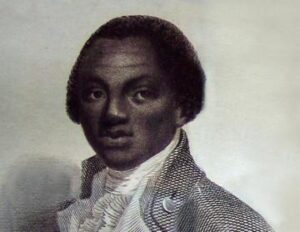
Olaudah Equiano was born around 1745 in Essaka, in the Kingdom of Benin (in present-day Nigeria). Kidnapped and enslaved at the age of around eleven, he was transported across the Atlantic to the Caribbean and then to the American colonies, where he was purchased by a British naval officer and renamed Gustavus Vassa — a name he used throughout his legal and commercial life while always asserting his African identity.
Equiano served his naval master in some of the most significant theatres of the Seven Years’ War, developing seamanship and commercial acumen that would eventually enable him to purchase his own freedom in 1766 for £40. He settled in London, became a leading figure in the Sons of Africa — an abolitionist group of African-born men living in Britain — and immersed himself in the intellectual and political life of the city.
The Interesting Narrative
In 1789, Equiano published *The Interesting Narrative of the Life of Olaudah Equiano, or Gustavus Vassa, the African, Written by Himself*. The title’s insistence on authorship — “Written by Himself” — was not a matter of vanity but of political necessity: many readers refused to believe an enslaved or formerly enslaved African was capable of producing a literary work of such sophistication.
The *Narrative* was an instant success. It went through nine editions in Equiano’s lifetime and was published across Europe and North America. Equiano toured Britain and Ireland promoting the book, speaking at meetings of the abolitionist movement and presenting copies to Members of Parliament. The book’s detailed account of his childhood in Africa, the horrors of the Middle Passage, and the daily degradations of slavery provided the abolitionist cause with vivid, personal, irrefutable testimony at precisely the moment it was most needed.
Legacy
Equiano died in 1797, a prosperous and celebrated figure. He is buried in Bunhill Fields in London, though the exact location of his grave remains uncertain. His *Narrative* is now recognised as one of the founding texts of Black Atlantic literature and a landmark of English prose. It is taught in universities worldwide and continues to reach new readers.
A dispute about the details of his early life — some scholars have suggested he may have been born in South Carolina rather than Africa — continues to be debated by historians. Whether or not his account of his African childhood is autobiographical or reconstructed from the testimonies of other enslaved people, the work’s moral and literary power remains undimmed.
Why is Olaudah Equiano Important?
At the age of forty-four he wrote and published his autobiography, ‘The Interesting Narrative of the Life of Olaudah Equiano, Or Gustavus Vassa, The African. Written by Himself,’ He registered it at Stationer’s Hall, London, in 1789.
More than two centuries later, this work is recognised not only as one of the first works published in England by an African. Equiano recalls his childhood in Essaka, where he was adorned in the tradition of the “greatest warriors.”He is unique in his recollection of traditional African life before the advent of the European slave trade.
Equiano was extremely well-travelled for his time. He not only travelled throughout the Americas, Turkey and the Mediterranean; but also participated in major naval battles during the French and Indian War (Seven Years’ War). He also took part in the search for a Northwest passage led by the Philips expedition of 1772-1773.
Equiano the Abolitionist
Due to his experiences as a slave and his somewhat fortuitous rise to prominence Equiano was held up as an example of excellence amongst Africans. Of course, he only seemed extraordinary in Britain, with relatively few Africans living in the country in his era. Equiano also records his central role, along with Granville Sharpe, the famous British abolitionist. Equiano informed Sharpe about the Zong massacre. The “Zong” was a slave ship whose crew murdered around 130 slaves en route to the Caribbean from Africa.
As a major voice in this movement, Equiano petitioned the Queen of England in 1788.
He was appointed commissary of provisions and stores to the expedition to resettle London’s poor Blacks in Sierra Leone, a British colony on the west coast of Africa, an ill-fated scheme designed to solve the issue of London’s Black Poor, many of whom were ‘Black Loyalists’ from Nova Scotia after fighting the American war of independence.
After returning to London, he became a prominent spokesperson for London’s black community and was one the leaders of the all-black abolitionist movement ‘The sons of Africa’
Working Class Activist
As well as championing black rights Equiano was also involved in campaigning in favour giving the vote to working men. He was an active member of the London Corresponding Society.
Marriage and Family
in 1792 Equiano married an English woman, Susanna Cullen. They were married in Soham Cambridgeshire. The couple went on to have two daughters. Sadly, Susanna died in 1796 aged just 36. Just one year later, on 31 March 1797 Equiano followed. He was buried at Whitefield’s Tabernacle, Tottenham Court Road, London.
Their eldest daughter Anna Maria only lived to be four years old. The surviving daughter, however, survived and inherited Equianos estate on her 21st birthday. She went on to marry Reverend Henry Bromley, a Congregationalist, in 1821. Bromley was pastor at Clavering in Essex.
- Related Links
- St Andrews Church, Ely – Plaques to Gustavus Vassa’s child
- Olaudah Equiano – BBC
- Cambridgeshire Archives and Local Studies Service (CALS)
- Details about Equiano’s life – Book Extracts
- Olaudah Equiano, or, Gustavus Vassa, the African – brycchancarey.com
Read Olaudah Equiano’s Book